
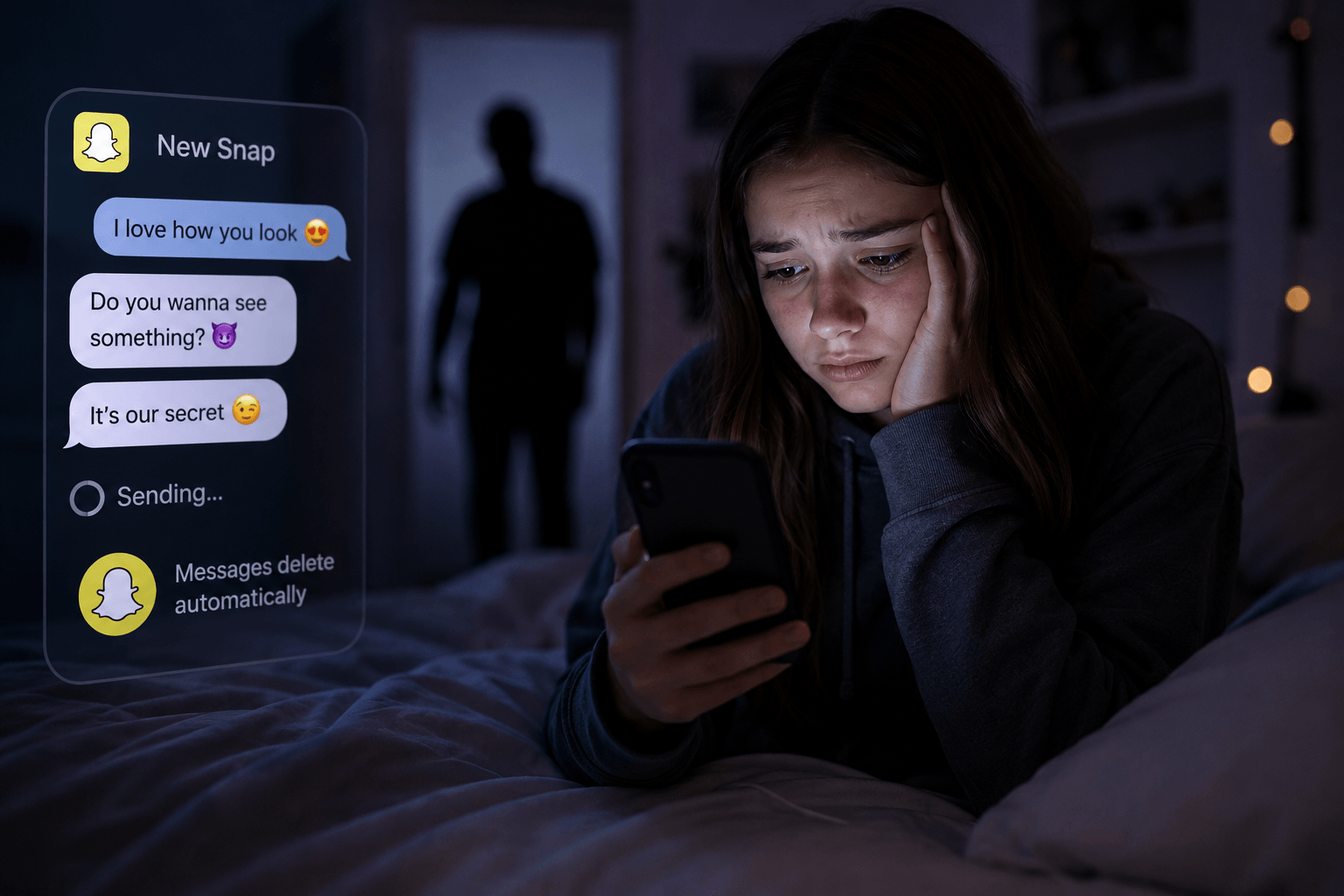
Your teenager handed a stranger their Snapchat username. The stranger sent a “harmless” message. Then another. Then a photo. Then a threat.
You found out weeks later or months later or only after the damage was already done.
If that sentence hit somewhere deep, you are not alone. Thousands of families across the United States have lived this exact nightmare, and a growing number of them have stopped blaming themselves and started asking the question that actually matters:
Why did Snapchat let this happen?
The answer, backed by internal documents, congressional testimony, and a wave of federal lawsuits, is one that should make every parent furious. Snapchat knew. They built features that made children easier to exploit. They collected data that proved the harm was happening. And they kept going anyway.
This article is for every parent, survivor, and advocate who wants to understand exactly what Snapchat did, what the law says about it, and what your family can do right now.
What Is the Snapchat Abuse Lawsuit?
Since 2023, thousands of individual lawsuits and a coordinated federal Multidistrict Litigation (MDL) have been filed against Snap Inc. the parent company of Snapchat alleging that the platform was designed in ways that predictably enabled the sexual exploitation, grooming, sextortion, and trafficking of minors.
These are not frivolous claims. They are backed by:
- Internal Snap communications showing executives were aware of child safety risks
- Federal investigations and criminal prosecutions tied to predators who specifically used Snapchat’s features to target victims
- Expert testimony on how Snapchat’s product design created conditions that predators exploited at scale
- Congressional hearings in which Snap’s own CEO was forced to publicly apologize to parents whose children were harmed or killed
The central legal argument is this: Snap Inc. is not just a neutral platform that bad people misused. Snap Inc. built a product that made abuse structurally easier and they did it while knowing children were using it by the tens of millions.
The Features That Made Snapchat a Predator’s Tool
This is the part of the story that most people do not fully understand. To see why Snapchat is legally and morally different from most platforms, you have to understand how its specific features created specific risks for children.
Disappearing Messages
Snapchat’s signature feature messages that vanish after being viewed was sold to the public as a privacy innovation. What it actually created was a mechanism for predators to communicate with children without leaving a permanent record. Grooming conversations, explicit images sent by adults, threats made in exchange for silence all of it could and did disappear before parents, investigators, or even the children themselves could document what was happening.
There is no reason a social platform aimed at teenagers needed this feature. Its primary beneficiaries, in the context of child exploitation, were the adults who wanted no evidence left behind.
Quick Add and Suggested Friends
Snapchat’s “Quick Add” feature recommended new friend connections based on mutual contacts and location data. For a predator, this was a gift. By cultivating a network of teen contacts, an adult could appear in the Quick Add feeds of dozens or hundreds of other teenagers making the initial approach look organic rather than targeted. Children were more likely to accept a friend request when Snapchat itself was suggesting the person as someone they might know.
Snap Map
Snap Map allows users to share their real-time location with their contacts. For adults who want to find and approach children in the physical world, a teenager who has shared their location on Snap Map is not protected they are trackable. Law enforcement cases have documented predators using Snap Map to identify when a minor was home alone, at school, or in a location where they could be approached.
The Ephemeral Economy of Sextortion
Sextortion- the crime of threatening to share explicit images of someone unless they comply with demands became dramatically easier on Snapchat because victims often did not know whether the predator had actually saved their images before they disappeared. The uncertainty itself became the weapon. Predators could tell a teenager that they screenshotted the image (whether or not they did) and use the threat of exposure to extract more content, money, or in-person contact.
Snap Inc. was aware of this dynamic. They had the data. They had the user reports. They had law enforcement notifications. They kept the features in place.
What Snap Inc. Knew and When
Internal documents that have surfaced through litigation paint a portrait of a company that was not blindsided by child safety failures. They were warned repeatedly, by their own teams, by researchers, and by law enforcement partners and they prioritized growth over protection.
Among the documented concerns raised internally and externally:
- Child safety advocates flagged Quick Add’s exploitation risk years before major litigation began
- Law enforcement agencies reported a pattern of Snapchat being the platform of choice for sextortion cases targeting minors
- Snap’s own trust and safety teams documented significant volumes of child sexual abuse material (CSAM) being shared on the platform
- Congressional investigators found that Snap had received thousands of reports of child exploitation and that its response systems were inadequate relative to the volume of abuse occurring
At the 2024 Senate Judiciary Committee hearing that made national headlines, Snap CEO Evan Spiegel sat in front of a room full of parents holding photos of children who had died some by suicide after sextortion, some in trafficking situations that began on Snapchat and offered an apology.
An apology is not accountability. Accountability is a lawsuit.
Who Can File a Snapchat Abuse Lawsuit?
If your child was sexually exploited, groomed, sextorted, or trafficked and Snapchat was the platform through which the harm occurred, your family may have a valid legal claim against Snap Inc.
Specifically, claims have been filed on behalf of:
Survivors of sextortion– minors (or adults who were minors at the time) who were coerced into providing sexual images or money under threat of exposure, where the exploitation occurred on or was initiated through Snapchat.
Survivors of grooming and sexual abuse– minors who were targeted by adults through Snapchat’s friend discovery or messaging features and subsequently abused.
Survivors of trafficking– victims who were recruited or controlled by traffickers who used Snapchat as their primary communication or recruitment tool.
Families of deceased victims– parents and siblings of minors who died by suicide or were killed as a direct result of abuse that occurred on or was facilitated through Snapchat.
Adults who were harmed as minors– if you are now over 18 but the harm occurred when you were a child, you may still have legal rights. Many states toll the statute of limitations for minors, meaning your window to file may have only recently opened. (For a full explanation of how these deadlines work, read our guide on Statute of Limitations Explained: How Much Time Do You Really Have to File a Lawsuit?)
Section 230: The Shield That Is Finally Cracking
For years, technology companies including Snap Inc. hid behind Section 230 of the Communications Decency Act- a 1996 federal law that broadly shields online platforms from liability for content posted by their users.
The argument was simple: Snapchat didn’t send the predatory messages. Users did. Therefore Snapchat bears no legal responsibility.
Courts across the country are increasingly rejecting this argument not because Section 230 has been repealed, but because the legal theories in these lawsuits are carefully constructed to target something different. They are not suing Snapchat for what its users posted. They are suing Snapchat for how it designed its product.
Product design is not user content. And product design decisions that predictably create conditions for the exploitation of children are not protected by Section 230.
This is the same legal framework being used in the Roblox child exploitation lawsuits and other social platform cases that have moved forward despite Section 230 defenses. Courts have allowed these cases to proceed, which is itself a signal about where the law is heading.
How Is Snap Inc. Different From Other Platforms?
A fair question and one defense attorneys will absolutely raise. Every major social platform has been used by bad actors. What makes Snapchat’s situation legally different?
The answer comes down to design choices that were unique to Snapchat and uniquely dangerous:
Disappearing messages were not an industry standard they were a Snapchat invention. No other major social platform combined this feature with a primarily teen user base and minimal age verification.
Quick Add’s location-based friend suggestions created pathways for strangers to access minors that are structurally different from, say, a public post on a feed. The suggestion implied social proximity. It made the first contact feel safer to the child than it actually was.
Snap Map’s real-time location sharing is a feature with no close equivalent on most competitor platforms in terms of precision and default accessibility to contacts.
The absence of meaningful parental controls during the years when most of the documented abuse occurred meant that parents had no visibility and no tools to protect children who were using the platform.
Each of these was a choice. Snap Inc. had engineers, product managers, trust and safety officers, and legal counsel. They made these choices with full knowledge that their platform’s primary demographic was teenagers.
What Compensation Can Victims Pursue?
Every case is different, and no attorney can guarantee a specific outcome. But the categories of harm that are typically compensable in these cases include:
Medical and mental health treatment costs– therapy, psychiatric care, hospitalization, and any ongoing treatment necessitated by the trauma.
Lost education and career opportunities– many survivors of serious childhood sexual exploitation experience disruptions to schooling, employment, and long-term earning capacity.
Pain and suffering– the psychological harm, the trauma, the loss of a normal childhood, and the long-term effects on relationships and self-worth.
Wrongful death damages– in cases where a minor died as a result of the exploitation, families can pursue compensation for their loss, including funeral costs, lost companionship, and emotional suffering.
Punitive damages– in cases where corporate conduct is found to be egregious and deliberate, courts can award damages designed not just to compensate victims but to punish and deter the defendant.
For a broader understanding of how courts calculate what cases like these are worth, see our article: What Is My Case Worth? How Compensation Is Calculated in Product Liability Claims
Real Families. Real Harm. Real Cases.
The lawsuits being filed are not abstractions. They represent the documented experiences of real children and real families.
The 14-Year-Old and the “Friend of a Friend”
A young girl in the Midwest accepted a Snapchat request from someone who appeared in her Quick Add as a mutual contact. Over several weeks, the adult posing as a teenage boy used disappearing messages to build a relationship. When he asked for photos and she initially refused, he told her he had screenshots of her prior messages and would “expose” her to her school. She complied. The abuse escalated for months before her mother discovered the conversation thread the predator had carelessly left visible on a secondary device.
Her family filed a lawsuit against Snap Inc., alleging that the Quick Add feature and disappearing message infrastructure created the exact conditions under which this abuse occurred and that Snap knew it.
The Boy Who Died at 17
A teenage boy in the South was contacted through Snapchat by someone who eventually obtained a sexually explicit image of him. The predator then threatened to send the image to the boy’s friends, family, and school unless he paid money. Terrified and ashamed, the boy did not tell his parents. Within weeks of the extortion beginning, he died by suicide.
His parents are among the families who appeared before Congress. They are also among the families pursuing legal action against Snap Inc.
These stories are not outliers. The FBI, the National Center for Missing and Exploited Children, and independent researchers have all documented a dramatic and documented pattern of Snapchat-facilitated exploitation of minors.
Platform Abuse Is Becoming a Legal Battleground- Snapchat Is Not Alone
The Snapchat lawsuits are part of a broader legal reckoning with how technology companies have treated child safety as a secondary concern behind growth metrics and engagement numbers.
Similar legal theories are driving:
- Roblox lawsuits– alleging the platform’s virtual economy and chat features enabled exploitation and predatory contact with children (learn more about the Roblox lawsuits here)
- Rideshare assault lawsuits– holding companies like Uber and Lyft accountable for assault facilitated through their platform’s inadequate driver screening (read about rideshare assault claims)
- Institutional sexual abuse cases– including LDS sexual abuse lawsuits and MD sexual abuse lawsuits, where powerful institutions prioritized their own protection over the children in their care
The common thread across all of these is a simple one: institutions and corporations that hold power over vulnerable people especially children have a legal and moral duty to use that power responsibly. When they don’t, the law provides a path to accountability.
What You Should Do Right Now If Your Child Was Harmed on Snapchat
1. Do not delete anything. Preserve every screenshot, every saved Snap, every notification, every conversation record you or your child have access to. Even if messages have disappeared from the app, device backups, notification logs, and third-party screenshots may contain critical evidence.
2. Document the timeline. Write down everything you remember when you first noticed something was wrong, what your child told you, what device they used, approximately when the contact began, and anything else you recall. Dates and sequences matter in litigation.
3. Report to law enforcement. File a report with your local police department and through the National Center for Missing and Exploited Children’s CyberTipline at www.missingkids.org. A police report creates an official record and may trigger investigations that produce evidence useful to your civil case.
4. Seek mental health support for your child immediately. Your child’s wellbeing is the priority. Professional trauma-informed therapy is essential, and the costs of that therapy may be recoverable in your lawsuit.
5. Contact a mass tort attorney who handles social media abuse cases. This is not a standard personal injury claim. You need attorneys who understand social media product liability, Section 230 defenses, and the specific litigation landscape around Snapchat. Legal Claim Counsel is available for a free, confidential consultation– no fees, no obligations, just answers.
Frequently Asked Questions
My child is still a minor. Can we file now, or do we have to wait?
You can file on behalf of a minor child right now. A parent or legal guardian can bring a claim on behalf of a minor. The statute of limitations for the child’s own future claim is typically tolled until they turn 18, but waiting unnecessarily is rarely advisable — evidence fades, witnesses become harder to locate, and the sooner you engage with the legal process, the better protected your family will be.
The abuse happened a few years ago. Is it too late?
Not necessarily. The discovery rule and minor tolling provisions mean that many claims that appear time-barred at first glance are still very much alive. The only way to know for certain is to speak with an attorney who can evaluate your specific timeline and state laws. Do not assume it is too late before making that call.
Snap released safety updates after the abuse happened. Does that hurt our case?
No and in many cases it actually helps. When a company releases a safety update after harm is documented, courts can interpret that as an acknowledgment that the prior version of the product was unsafe. It is one form of evidence that the design defect was known and fixable.
Will my family have to go to court?
Most mass tort cases resolve through settlement rather than trial. But whether your case settles or goes to court depends on many factors. Your attorney’s job is to maximize your family’s outcome through whichever path achieves that.
What does it cost to find out if we have a case?
Nothing. Every consultation with Legal Claim Counsel is completely free and completely confidential. All cases are handled on a contingency fee basis meaning you pay nothing unless we win. There is no financial risk to picking up the phone and getting an answer.
The Bottom Line
Snap Inc. built features that made children easier to exploit. They had the data. They had the warnings. They had the reports from law enforcement. They chose growth over safety for long enough that thousands of families paid the price.
The lawsuits now moving through the federal court system are not about vengeance. They are about accountability and about making sure that the financial cost of ignoring child safety is high enough that no technology company ever makes the same calculation again.
If your family was affected, your time to act may be limited. Every day that passes after you become aware of a potential claim is a day the statute of limitations clock may be running.
Contact Legal Claim Counsel today for a free, confidential case review. Tell us what happened. We will tell you where you stand.
You should not have to carry this alone. And you do not have to.
Legal Disclaimer: This article is provided for informational purposes only and does not constitute legal advice. No attorney-client relationship is created by reading this content. If you believe your family has a claim, please contact our office directly for a free consultation specific to your circumstances.
Related Articles:
- Statute of Limitations Explained: How Much Time Do You Really Have to File a Lawsuit?
- Roblox Child Exploitation Lawsuits 2026: A Parent’s Step-by-Step Guide to Taking Legal Action
- I Was Assaulted in an Uber — Here’s Exactly What Happened When I Filed a Lawsuit
- California Sexual Abuse Lawsuit: How Long Do Survivors Have to File a Claim in 2026?
- Top 5 Mistakes Victims Make When Filing a Mass Tort Claim