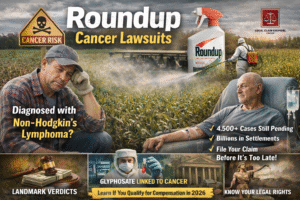
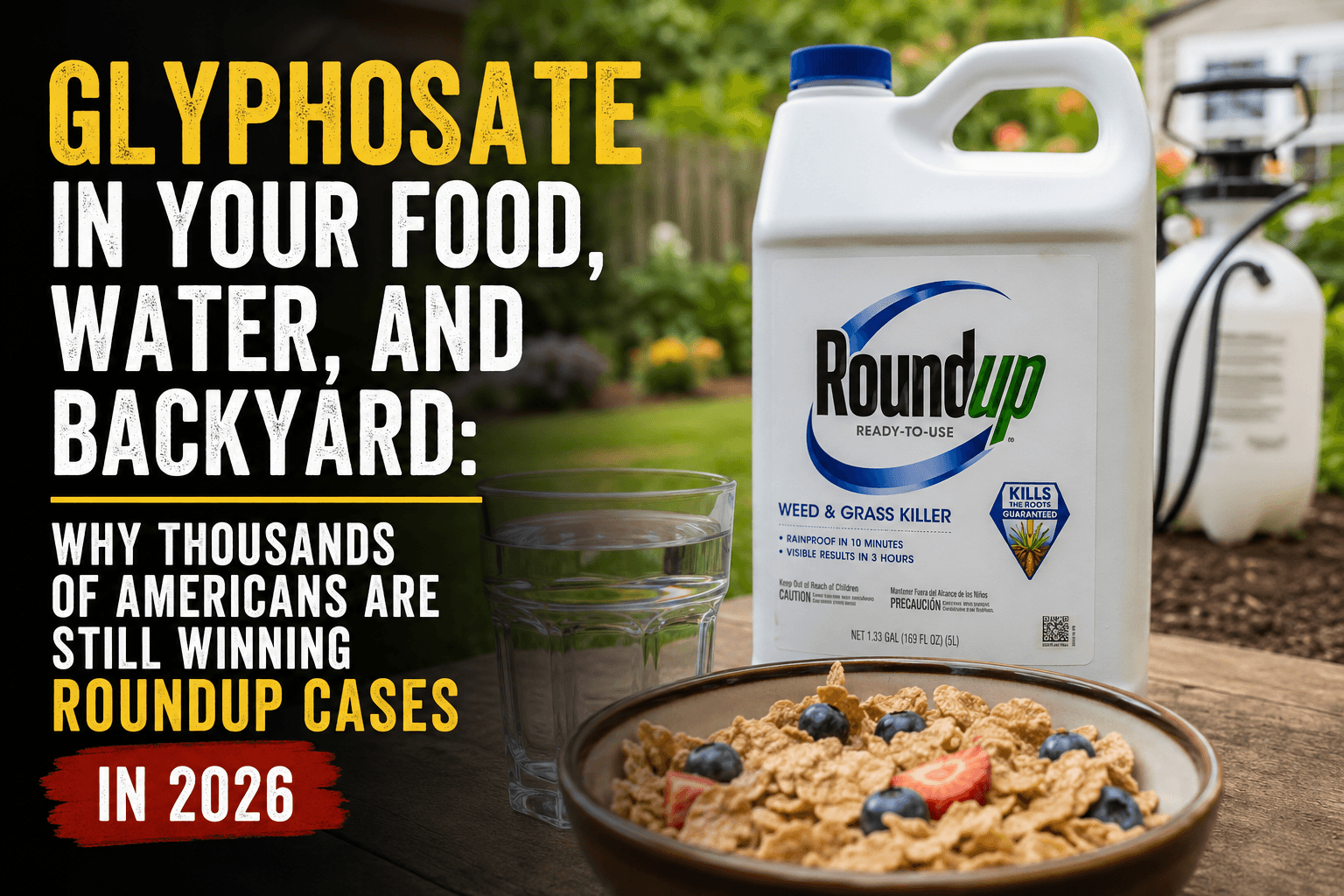
You probably used it without a second thought.
Maybe it was that familiar yellow-and-orange bottle you grabbed at the hardware store on a Saturday morning. Maybe it was the stuff your employer handed you before you walked the fields, the school grounds, or the golf course fairways for the tenth season in a row. Maybe you never even held the bottle yourself- you just ate the food it was sprayed on, drank the water that ran off those treated fields, and let it enter your body the way millions of Americans do every single day, without knowing.
Glyphosate: the active ingredient in Roundup- is now the most widely used herbicide on Earth. And in 2026, thousands of Americans who were never told about its risks are still filing lawsuits, still winning verdicts, and still collecting significant compensation from one of the largest corporations in the world.
This article is for anyone who has ever used Roundup, worked around it, or simply wondered whether their cancer diagnosis might be connected to a product they were told was perfectly safe. By the time you finish reading, you will understand exactly what glyphosate does to the human body, what the science actually says, why courts keep siding with plaintiffs, and whether you still have time to file a claim.
What Is Glyphosate, and Why Is It Everywhere?
Glyphosate was first developed by Monsanto and introduced to the market in 1974 under the brand name Roundup. It works by blocking a specific enzyme pathway in plants — one that humans and animals supposedly don’t share- which is why Monsanto marketed it as safe for mammals. Farmers could spray it freely, kill weeds, and theoretically leave their crops and the surrounding ecosystem unharmed.
That promise got supercharged in the 1990s when Monsanto introduced genetically modified “Roundup Ready” crops corn, soybeans, cotton, canola- engineered specifically to survive glyphosate applications. Suddenly farmers weren’t just using Roundup to prep fields before planting. They were spraying it directly on growing crops, multiple times per season. Usage exploded. By some estimates, over 1.4 billion pounds of glyphosate are applied globally every year, and the United States accounts for a massive share of that total.
Here is where it gets personal for most Americans: glyphosate doesn’t stay in the field.
Residues have been detected in tap water, oat-based cereals, baby food, wheat products, beer, and wine. The Environmental Working Group tested popular oat products and found glyphosate in nearly all of them, including products marketed to children. The USDA has found glyphosate residues in honey, soybean oil, and corn products. Studies have detected it in human urine, blood, and breast milk.
You have almost certainly consumed glyphosate. The question that courts have been wrestling with and increasingly answering is what that exposure has done to your health.
The Cancer Connection: What the Science Actually Says
For years, Monsanto (now owned by Bayer following a 2018 acquisition) insisted glyphosate was safe. They pointed to studies from the EPA and other regulatory bodies that found no conclusive evidence of carcinogenicity in humans.
Then came 2015.
The World Health Organization’s International Agency for Research on Cancer (IARC) widely considered the gold standard of cancer research globally classified glyphosate as “probably carcinogenic to humans.” This classification was based on an extensive review of epidemiological studies, animal studies, and mechanistic evidence. The cancer most strongly linked to glyphosate exposure was non-Hodgkin’s lymphoma (NHL), a cancer of the lymphatic system that includes dozens of subtypes.
The NHL connection is not a fringe finding. Multiple peer-reviewed studies have found elevated rates of NHL in agricultural workers with regular glyphosate exposure. A landmark 2019 meta-analysis published in Mutation Research found that people with high glyphosate exposure had a 41% increased risk of developing non-Hodgkin’s lymphoma compared to those with no exposure.
Beyond cancer, emerging research has raised concerns about glyphosate’s potential effects on:
- The gut microbiome: glyphosate may disrupt beneficial gut bacteria, with downstream effects on immunity and systemic inflammation
- The endocrine system: some studies suggest glyphosate may act as an endocrine disruptor at low doses
- Liver and kidney function: animal studies have shown changes in liver enzyme levels with chronic low-dose exposure
- Reproductive outcomes: several studies have found associations with birth defects and developmental issues in communities with high agricultural glyphosate use
The EPA has maintained its position that glyphosate is unlikely to be carcinogenic to humans when used as directed. But the EPA’s own scientific review board has challenged parts of that assessment, and federal courts have repeatedly allowed cancer cases to proceed to trial and juries have repeatedly sided with plaintiffs.
That tells you something important.
Why Courts Keep Ruling Against Bayer: The Internal Documents That Changed Everything
If Roundup cases were only about disputed science, many of them might never have made it to verdict. What transformed this litigation and what continues to drive massive jury awards in 2026 is what Bayer’s own internal documents revealed.
During discovery in the early cases, plaintiffs’ attorneys obtained thousands of internal Monsanto communications. What they found was damning:
Monsanto knew. Internal emails showed company scientists expressing private concerns about glyphosate and cancer long before those concerns became public. Documents showed the company worked to discredit independent researchers who published unfavorable findings. There is evidence that Monsanto employees were involved in ghostwriting scientific papers and then recruiting credentialed scientists to sign them effectively manufacturing the appearance of independent scientific consensus.
In one case, a former EPA employee was accused of coordinating with Monsanto to influence the agency’s internal review of glyphosate. Bayer has disputed the characterization of these documents, but juries have seen them, read them, and delivered their verdicts accordingly.
This is what legal professionals call fraudulent concealment and it matters enormously for your case. When a company deliberately hides what it knows about a product’s dangers, courts can toll (pause) the statute of limitations for the period during which that information was suppressed. In plain terms: even if you were exposed to Roundup decades ago, you may not have missed your legal window. As we explain in detail on our Statute of Limitations page, the discovery rule and fraudulent concealment doctrines protect many plaintiffs who assume their time has run out.
The Verdict Scoreboard: What Juries Have Been Awarding
Bayer has paid dearly for what Monsanto did. Here is a snapshot of where the litigation stands as of 2026:
- $10+ billion paid in settlements to resolve the majority of filed claims since 2020
- $5.9 billion additionally set aside for ongoing and future claims
- More than 114,000 cases settled or dismissed across federal and state courts
- Approximately 4,400+ cases still pending in federal MDL before Judge William H. Orrick III
- 60,000+ individual state court cases still active
Recent jury verdicts have continued to be significant:
- A Georgia jury awarded $2.1 billion to John Barnes, a non-Hodgkin’s lymphoma patient who used Roundup regularly for years
- A Philadelphia jury awarded $78 million in a separate case
- A Pennsylvania jury initially awarded $2.25 billion to John McKivison later reduced on appeal, but still substantial
Bayer is appealing many of these awards, and appellate courts have occasionally reduced punitive damage figures. But the pattern is clear: when juries hear the full story of what Monsanto knew, they are angry. And they are making Bayer pay.
Who Is Most at Risk? Glyphosate Exposure Profiles
Not everyone carries the same level of risk. The clearest and most legally actionable cases involve people with sustained, direct exposure to glyphosate over time. Here are the groups we see most often:
Farm and Agricultural Workers
Anyone who has mixed, loaded, or applied glyphosate-based products as part of their job represents the highest exposure group. Many agricultural workers applied Roundup for decades without protective equipment because they were told it was safe. If you worked in farming and have been diagnosed with non-Hodgkin’s lymphoma or a related blood cancer, your claim deserves immediate attention.
Landscapers, Groundskeepers, and Golf Course Workers
Professional landscapers and groundskeepers often use herbicides on a daily basis, sometimes across multiple properties. Golf course maintenance workers may have some of the highest cumulative exposure levels of any occupational group. These are strong cases.
School and Park Maintenance Workers
Public schools, parks, and municipal spaces have used Roundup extensively for decades. If you maintained those grounds, you may have had regular, high-volume exposure that qualifies under current litigation standards.
Home Gardeners with Heavy Use
While the risk is lower than for occupational users, people who used Roundup frequently in their home gardens and yards over many years especially before wearing gloves, masks, or protective clothing have filed successful claims, particularly where exposure was sustained and documented.
People Who Lived Near Treated Agricultural Areas
Emerging research suggests that communities near heavily sprayed agricultural land may have elevated glyphosate levels in their local water supply. This is an evolving area of litigation. If you’ve lived for years near intensively farmed land and received an NHL diagnosis, it is worth discussing your situation with an attorney.
The Cancers That Qualify: Know Your Diagnosis
Not every cancer automatically qualifies for a Roundup lawsuit. The cases that have been most successful involve diagnoses that the scientific and legal record most strongly connects to glyphosate exposure. These include:
- Non-Hodgkin’s Lymphoma (all subtypes the primary diagnosis in most cases)
- B-cell Lymphoma
- Follicular Lymphoma
- Diffuse Large B-cell Lymphoma (DLBCL)
- Mantle Cell Lymphoma
- Marginal Zone Lymphoma
- Burkitt Lymphoma
- Hairy Cell Leukemia
- Small Lymphocytic Lymphoma (SLL)
- Chronic Lymphocytic Leukemia (CLL)
- T-cell Lymphoma and T-cell Leukemia
- Lymphoblastic Lymphoma
If you have been diagnosed with any of these conditions and have a history of glyphosate exposure, you should speak with an attorney before assuming you do not qualify or that too much time has passed.
How Glyphosate Gets Into Your Body Without You Knowing
One of the most important things for potential plaintiffs to understand is that you do not have to have been a farmer or professional landscaper to have experienced significant exposure. Here are the pathways most people never consider:
Dietary exposure: Oats, wheat, corn, soy, and products made from them routinely carry detectable glyphosate residue. Breakfast cereals, granola bars, crackers, bread, and even some products labeled “natural” have tested positive in independent studies. A 2018 Environmental Working Group analysis found glyphosate in all but 2 of 45 oat-based food products tested.
Drinking water: Glyphosate has been detected in groundwater, streams, and municipal water supplies in agricultural regions. While levels typically fall below EPA limits, those limits themselves are contested by many public health researchers who argue they were set before adequate long-term carcinogenicity studies were completed.
Air and drift: When crops are sprayed aerially or in windy conditions, glyphosate can drift considerable distances and be inhaled by people living or working nearby.
Skin absorption: Glyphosate can be absorbed through the skin during handling which is why occupational exposure cases involve people who often did not wear adequate protective gear, particularly during the decades when the product was marketed as essentially harmless.
Glyphosate, PFAS, and the Broader Toxic Exposure Landscape
If you are dealing with a glyphosate-related health issue, it is worth knowing that you may also have been exposed to other harmful chemicals depending on your occupation and geography. Agricultural areas often see overlapping exposure to multiple chemical hazards.
Our legal team also handles PFAS lawsuits cases involving “forever chemicals” that have contaminated drinking water in hundreds of U.S. communities, many of them in the same rural and agricultural regions where glyphosate use is heaviest. And if you worked with other agricultural herbicides, you may want to explore our Paraquat lawsuit page, as Paraquat exposure has been linked to Parkinson’s disease in a growing body of litigation.
Toxic exposure cases frequently involve multiple overlapping legal claims. An experienced mass tort attorney can help you identify every avenue available to you.
Do You Still Have Time to File? Understanding Your Legal Window in 2026
This is the question we get most often, and the honest answer is: you may have more time than you think.
The statute of limitations for personal injury and product liability claims varies by state, typically ranging from one to three years. But, and this is critical the clock usually starts not from when you were first exposed to Roundup, but from when you discovered (or reasonably should have discovered) that your cancer was connected to that exposure.
This is called the discovery rule, and it has preserved the rights of countless Roundup plaintiffs who assumed their window had long closed.
Consider this scenario: if you used Roundup throughout the 1990s and 2000s, were diagnosed with non-Hodgkin’s lymphoma in 2022, and only learned about the glyphosate-cancer connection in late 2023 after seeing a news report- your clock likely started in 2023, not in 1999. In most states, that means you may still have a viable claim today.
Additionally, Bayer’s deliberate concealment of internal safety concerns means the fraudulent concealment doctrine may further extend your legal window, even in states with strict limitations periods. Courts have recognized that Monsanto withheld information that would have allowed patients to connect the dots sooner and they have applied tolling protections accordingly.
You can read a full, detailed breakdown of how statutes of limitations work in toxic exposure cases on our Statute of Limitations blog post. But please do not wait to read it before making a phone call.
What Compensation Can You Realistically Expect?
Every case is different. Settlement amounts and verdicts depend on the severity of your diagnosis, the duration and intensity of your exposure, how well-documented your claim is, and factors specific to your state’s law. That said, here is what the landscape looks like:
Individual Roundup settlement payments from Bayer’s existing programs have ranged from roughly $5,000 to $250,000, with the higher end reserved for cases involving severe, well-documented NHL with strong exposure evidence. Jury verdicts, when cases go to trial, have produced far larger numbers in the billions in some instances though these are often reduced on appeal.
In a typical claim, compensation may cover:
- Past and future medical expenses (chemotherapy, radiation, immunotherapy, hospitalization, follow-up care)
- Lost wages and diminished earning capacity
- Pain and suffering
- Emotional distress
- Costs borne by family members who served as caregivers
- In wrongful death cases, the full range of damages on behalf of surviving family members
Our What Is My Case Worth article explains in detail how compensation is calculated in product liability cases. It is worth reading before your first consultation so you arrive informed.
The Process: What Actually Happens After You Call
Many people put off calling a lawyer because they imagine it will be complicated, expensive, or time-consuming. The reality is much simpler.
Step 1. Free, confidential case evaluation. You speak with a member of our team, describe your exposure history and diagnosis, and we assess whether your situation qualifies. This costs you nothing and obligates you to nothing.
Step 2. Documentation gathering. If you have a viable claim, we help you gather relevant materials: medical records confirming your diagnosis, records of where and how long you used Roundup or worked around it, employment records if your exposure was occupational, and any other supporting documentation.
Step 3. Filing your claim. Your attorneys handle all legal filings, including registration with any active MDL if applicable. You do not navigate this process alone.
Step 4. Negotiation or trial. Most cases resolve through settlement. If Bayer does not offer a fair settlement, your legal team takes the case to trial. You are informed and involved throughout.
You pay nothing unless we win. All Roundup cases at Legal Claim Counsel are handled on a contingency fee basis- no upfront costs, no hourly billing, and no fees unless you receive compensation.
We also encourage you to read our guide on common mistakes victims make when filing mass tort claims before you begin. Knowing what to avoid is as important as knowing what to do.
Frequently Asked Questions About Roundup Lawsuits in 2026
I used Roundup for years but haven’t been diagnosed with cancer. Can I still file?
Currently, Roundup lawsuits are filed on behalf of people who have already received qualifying cancer diagnoses. There is no active program for people exposed but currently healthy. However, if you have a history of significant exposure, it is worth monitoring your health closely and discussing appropriate screenings with your doctor. If a diagnosis does come, contact us immediately your exposure history is documentation that will matter.
My diagnosis was several years ago. Is it too late?
Not necessarily. As explained above, the discovery rule starts the clock when you learned or should have learned about the connection between your diagnosis and Roundup not when you were first exposed or even first diagnosed. If you were recently made aware of the possible link, your window may still be open. The only way to know for certain is to speak with an attorney.
Bayer has already settled over 100,000 claims. Are there still opportunities?
Yes. The settlement programs that resolved the bulk of earlier cases covered plaintiffs who registered by certain deadlines. Tens of thousands of new and additional claims remain in litigation, and Bayer continues to face ongoing exposure for cases outside earlier settlement rounds. The litigation is very much alive in 2026.
I was a farmworker who used Roundup but never thought to file. Do I qualify?
Farmworkers and agricultural laborers are among the strongest potential plaintiffs in Roundup litigation due to their high, sustained occupational exposure. If you have been diagnosed with NHL or a related blood cancer and worked with glyphosate-based products, please contact us for a free evaluation. Language barriers or immigration status are not disqualifying factors.
Does it matter which specific Roundup product I used?
Roundup has been sold under numerous product names and formulations over the decades, all containing glyphosate as the active ingredient. Most formulations commercially available since the 1980s may be relevant to your claim. The specific product matters less than your overall pattern of exposure.
The Bottom Line: Glyphosate Is Not Just a Farming Issue Anymore
For decades, Roundup was treated as a background part of American life the stuff you used to kill dandelions, the chemical sprayed on grain fields that ended up in your cereal bowl, the herbicide applied to school lawns by the groundskeeper who never wore a mask.
That era of unquestioned acceptance is over.
The science has caught up. The courts have weighed in. Juries across the country have seen the internal documents, heard the testimony, and delivered landmark verdicts. Bayer has paid billions and continues to face billions more in exposure.
If you or someone you love has been diagnosed with non-Hodgkin’s lymphoma or a related blood cancer and you have any history of glyphosate exposure, whether occupational or residential the most important thing you can do right now is find out where you stand. Not next month. Not after you “look into it a little more.” Now.
The consultation is free. The conversation is confidential. And what you learn could mean the difference between the justice you deserve and a legal window that closes permanently while you wait.
Contact Legal Claim Counsel today for your free, no-obligation case evaluation →
Related Resources from Legal Claim Counsel
- Roundup Lawsuit- Full Information for Cancer Victims
- Statute of Limitations: How Much Time Do You Really Have to File?
- What Is My Case Worth? How Compensation Is Calculated
- Top 5 Mistakes Victims Make When Filing a Mass Tort Claim
- PFAS Lawsuit- Forever Chemicals in Your Water
- Paraquat Lawsuit- Herbicide Linked to Parkinson’s Disease
Legal Disclaimer: This article is provided for general informational purposes only and does not constitute legal advice. No attorney-client relationship is formed by reading this content. Statutes of limitations, eligibility criteria, and compensation amounts vary by state, individual circumstance, and the specific facts of your case. Contact Legal Claim Counsel for a free, confidential consultation specific to your situation.
Tags: Roundup Lawsuit 2026, Glyphosate Cancer, Non-Hodgkin’s Lymphoma Lawsuit, Bayer Roundup Settlement, Glyphosate in Food, Roundup Weed Killer Lawsuit, Mass Tort Attorney, Roundup MDL, Glyphosate Health Risks, Agricultural Cancer Claims