
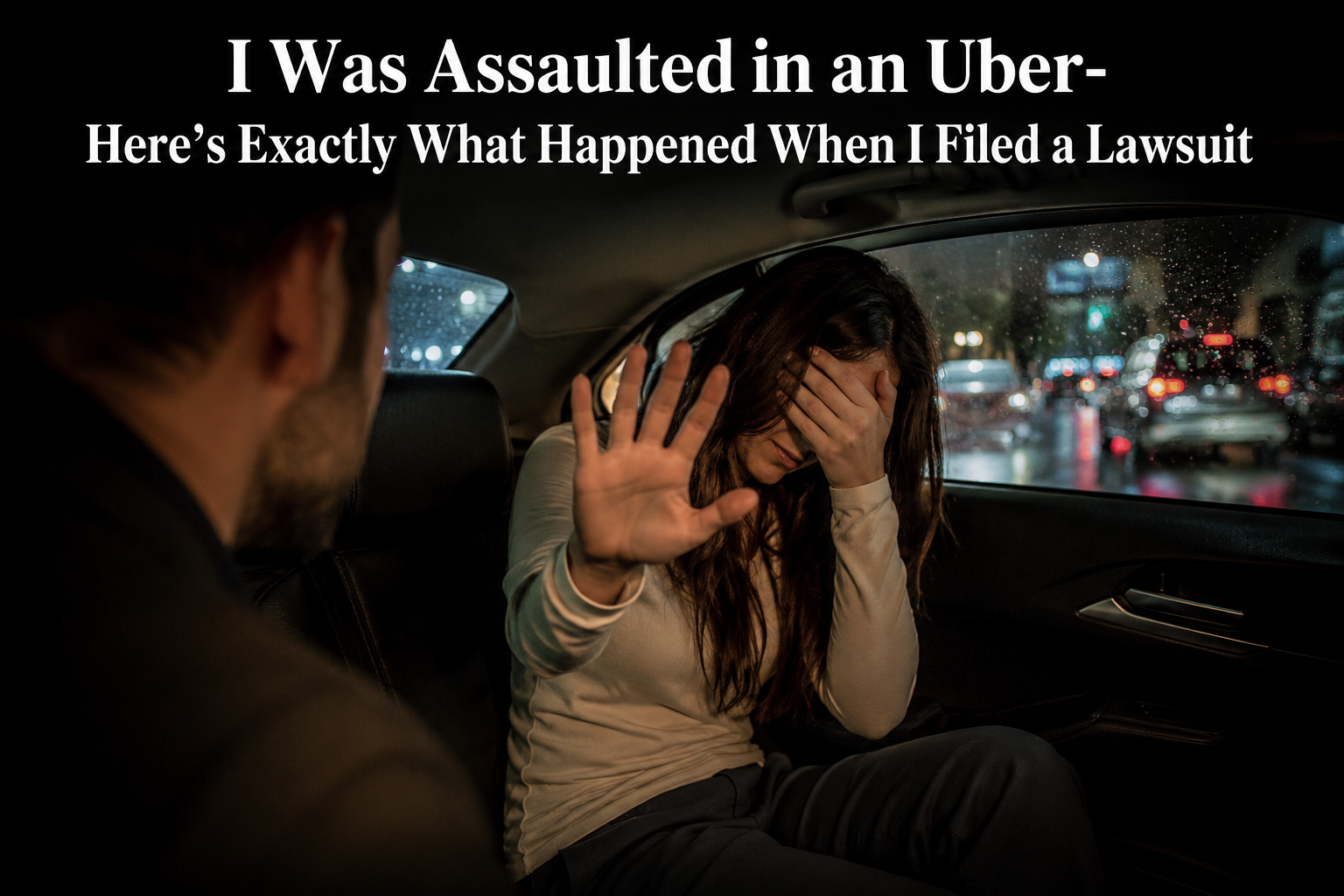
Nobody gets into an Uber expecting it to be the worst night of their life. But for thousands of passengers every year across the United States, that’s exactly what happens. This is a detailed, unfiltered account of what the legal process actually looks like after a rideshare assault- the moments you don’t see in press releases, the decisions that feel impossible, and the things that actually matter when you decide to fight back.
If you or someone you love has been assaulted, harassed, or harmed by an Uber or Lyft driver or inside one of their vehicles this post is for you. Not legalese. Not corporate disclaimers. Just the truth, told plainly, by people who have walked this road alongside survivors for decades.
The Night Everything Changed
It started like any other rideshare trip. A late evening, a phone pulled out, an app opened. The kind of ordinary moment you’d never think twice about. The kind that, in the space of a few minutes, can divide your life into “before” and “after.”
When the driver’s behavior turned threatening and then violent the instinct wasn’t to think about lawsuits. It was to survive. To get out. To get somewhere safe. The legal system was the last thing on anyone’s mind in that moment.
And that is completely, entirely, understandably human.
What most survivors don’t realize and what nobody tells you in the immediate aftermath is that the decisions you make in the hours, days, and weeks after an assault can dramatically affect your ability to hold Uber accountable. Not because the burden should be on you. It absolutely should not be. But because understanding the system is how you use it.
⚠️ Critical First Step
If you were recently assaulted in an Uber or Lyft, your very first call after getting to safety should be to law enforcement. Your second should be to a legal team that handles rideshare assault cases. Time is not your friend here and understanding your rights as a rideshare assault victim starts with acting quickly.
Step One: The Chaos Immediately After What Actually Happened
The first 24 hours after an assault are a blur for most survivors. Shock, fear, shame, disbelief all of it floods in at once. Here is what happened, and what any survivor should know about why each moment matters legally.
1
Getting out and getting safe
The priority, always, is physical safety. If the assault occurs while the vehicle is moving, getting to a populated area and calling 911 is the immediate goal. In this case, that meant stopping at a gas station and asking a stranger to stay until police arrived.
2
Calling the police- even when it feels pointless
Law enforcement reports become critical legal documents later. Even if officers seem dismissive, even if you’re unsure what to say, even if nothing feels “official enough” file the report. Get the case number. This paper trail is foundational to any civil claim against Uber.
3
Going to the hospital
Medical records serve two purposes: they document your injuries for treatment, and they create a timestamped, clinical record that courts take seriously. Refusing medical care, or delaying it, can be used against you later by Uber’s legal team to minimize the severity of your injuries.
4
Screenshotting everything in the app
The Uber trip receipt. The driver’s name, photo, and vehicle. The route taken. The timestamp. All of it. Take screenshots before you close the app some survivors have reported that trips were altered or disappeared from their history. These screenshots become evidence.
5
Not reporting to Uber yet
This sounds counterintuitive. But before you report through Uber’s in-app system, talk to an attorney. Uber’s safety team is not your advocate they are Uber’s first line of damage control. Anything you say through their system can be used to build their defense, not yours.
The Hard Truth About Uber’s Safety Record
Uber published its first-ever safety report in 2019, and the numbers were staggering. The company confirmed nearly 6,000 reports of sexual assault across just two years in the United States. And those are only the reported cases. The actual number, researchers believe, is far higher, because assault is chronically underreported especially when the alleged perpetrator is a stranger in a moving vehicle.
6,000+Sexual assaults reported to Uber (2017–2018)
3,824Incidents of non-consensual touching reported in 2020
$9M+Uber has paid in settlements related to assault claims
2–3 yrsTypical statute of limitations window for civil claims
What those numbers represent isn’t just a liability problem for a tech company. They represent real people whose lives were altered in the back seat of a vehicle they trusted to get them home safely. And they represent a company that had warning signs and chose, repeatedly, to prioritize growth over passenger safety.
Know your time limits: One of the most common reasons victims lose their right to sue is simply waiting too long. Learn exactly how deadlines work in our detailed guide on statutes of limitations and how much time you really have to file a lawsuit.
What Uber’s Defense Strategy Actually Looks Like
This is where things get uncomfortable. But survivors deserve to know the truth about what they’re up against because Uber does not roll over when a lawsuit is filed. Quite the opposite.
Uber’s legal team some of the most well-funded corporate defense attorneys in the country will typically pursue several lines of defense simultaneously:
1. The “Independent Contractor” Shield
Uber has spent enormous resources legally classifying its drivers as independent contractors rather than employees. The purpose of this classification isn’t just financial, it’s a legal firewall. If drivers aren’t employees, Uber argues, then Uber isn’t responsible for their actions. This is the argument that courts across the country have been systematically dismantling. But Uber will still make it, every time.
2. Challenging the Severity of Your Injuries
Uber’s legal team will examine every medical record, every social media post, every statement you’ve made since the incident. They will look for anything that suggests your injuries were less severe than claimed, or that you recovered faster than you say. This is not personal it is strategy. Your attorney will prepare you for it.
3. Questioning the Timeline
Discrepancies in your account even small, innocent ones caused by shock or trauma will be magnified. The defense will probe every detail of what happened, in what order, and what you did (or didn’t do) immediately after. This is why detailed contemporaneous notes are invaluable.
4. Arbitration Clauses
When you click “I agree” on Uber’s Terms of Service, you likely waive your right to a jury trial. Uber has historically tried to force assault claims into private arbitration a process that happens behind closed doors, without a jury, and with outcomes that heavily favor corporations. Courts have been increasingly sympathetic to survivors who challenge these clauses in sexual assault cases, particularly following the Ending Forced Arbitration of Sexual Assault and Sexual Harassment Act signed into law in 2022.
“Uber will tell you they care about safety. Their legal strategy will tell you something different. Your job and your attorney’s job is to hold them to the standard their marketing promises.”
Filing the Lawsuit What the Process Actually Looked Like
Once legal counsel was retained, the process moved in distinct phases. Here is an honest, month-by-month account of what that timeline looks like for most rideshare assault cases.
Week 1–2
Retaining Counsel and Case Evaluation
A reputable rideshare assault attorney will do an initial case review at no cost. During this consultation, they’ll assess the police report, medical records, and your account of events. They’ll also evaluate whether the arbitration clause in Uber’s TOS applies and whether it can be challenged. At Legal Claim Counsel, this initial review is completely free and confidential.
Week 3–8
Evidence Gathering and Demand Letter
Your attorney will subpoena Uber’s driver records background checks, complaints from other passengers, prior incidents involving the same driver. They will also gather your medical bills, therapy records, lost income documentation, and statements from anyone who witnessed the aftermath. A formal demand letter is then sent to Uber’s legal team outlining the damages sought.
Month 2–4
Uber’s Response and Early Negotiations
Uber rarely immediately admits liability. Their legal team will respond to the demand letter, often with a low-ball offer or a denial. Your attorney will advise whether to negotiate from this point or proceed toward formal litigation. In many cases, Uber eventually settles but the settlement amount often depends on how aggressively your legal team pursues the claim.
Month 4–12+
Discovery and Depositions
If the case proceeds to litigation, both sides exchange evidence through a process called discovery. You may be deposed asked questions under oath by Uber’s attorneys. Your attorney will prepare you extensively for this. Discovery often surfaces damning internal Uber documents about their knowledge of driver risks information that can dramatically strengthen your position.
Settlement or Trial
Resolution
The vast majority of rideshare assault cases settle before trial. Settlements offer privacy and faster resolution. If your case goes to trial, a jury will decide the outcome and juries have historically been sympathetic to assault survivors against large corporations. Your attorney will guide you through which path is right for your specific circumstances.
What Compensation Can You Actually Recover?
This is the question most survivors are afraid to ask, as though asking about money makes the experience less legitimate. It does not. Financial compensation in civil cases exists for important reasons it acknowledges the real harm done and creates accountability that criminal convictions alone do not always achieve.
In a rideshare assault case against Uber, compensable damages typically fall into several categories:
- Medical expenses– Emergency care, surgery, hospital stays, ongoing treatment
- Mental health treatment– Therapy, psychiatric care, PTSD treatment, medication
- Lost wages– Income lost during recovery, reduced earning capacity if the trauma affects your ability to work long-term
- Pain and suffering– Non-economic damages for the physical pain and emotional anguish of the assault itself
- Loss of enjoyment of life– For survivors whose ability to engage with normal life activities has been diminished
- Punitive damages– In cases where Uber’s negligence is found to be especially egregious, additional damages designed to punish the company and deter future harm
You’re not alone in this fight: Thousands of people have filed sexual abuse and assault-related civil claims in recent years. Our team handles sexual abuse lawsuits across multiple contexts and can help you understand how your case fits into the broader legal landscape.
The Emotional Reality Nobody Talks About
Legal guides love to focus on process. Evidence. Timelines. Compensation. What they rarely discuss is the emotional weight of going up against a corporation the size of Uber while simultaneously processing trauma.
The deposition is the hardest part. Sitting across from Uber’s attorneys and being asked detailed questions about the worst moment of your life while under oath, while they look for inconsistencies is brutal. Being prepared by your attorney for this process makes it survivable. Walking in unprepared does not.
The waiting is its own kind of torture. Litigation moves slowly. There will be months where nothing visible seems to be happening. Your attorney is working during this time but you won’t always see it. Maintaining open communication with your legal team is essential for your own mental health during this period.
Settling doesn’t mean losing. Many survivors feel a complicated grief when a case settles rather than going to trial as though justice wasn’t fully served. But a settlement that holds Uber financially accountable, that forces them to pay, that creates a record that is justice. It does not look like a movie, but it is real.
Therapy and legal counsel are not mutually exclusive. In fact, they are deeply complementary. The healthier and more supported you are psychologically, the more clearly you can engage with the legal process. Your attorney is not your therapist and your therapist cannot be your attorney. Both matter.
Uber’s Background Check Problem The Structural Failure
A recurring theme in rideshare assault litigation is not just the individual driver’s behavior it’s Uber’s systemic failure to screen out dangerous individuals before putting them behind the wheel with strangers.
Unlike traditional taxi companies and car services in many jurisdictions, Uber relies on automated, database-driven background checks rather than fingerprint-based screening. The result is predictable: drivers with criminal records, including prior assault convictions, have slipped through. Drivers who were flagged by other passengers sometimes repeatedly were allowed to continue operating.
Internal Uber documents obtained through litigation in multiple cases have revealed that the company was aware of safety shortcomings and continued to grow its driver pool aggressively regardless. This is the kind of corporate negligence that fuels punitive damage claims and it’s the kind of evidence that a skilled legal team knows how to surface.
🔍 Legal Insight
One of the most powerful aspects of a civil lawsuit against Uber is the discovery process it compels Uber to turn over internal communications, safety reports, and driver complaint histories that would never be made public otherwise. Your case may reveal patterns that ultimately protect the next passenger.
Frequently Asked Questions From Survivors
1. What if I didn’t report to the police that same night?
You can still file a civil claim. While a contemporaneous police report strengthens your case, the absence of one does not end it. Speak to an attorney about what documentation you do have.
2. I used the Uber app to report the incident. Does that hurt my case?
Not necessarily- but it does mean Uber’s legal team now has your initial account of events. Your attorney will review what you submitted and help contextualize it as part of your overall case strategy.
3. Can I sue both the driver and Uber?
Yes. In most cases, you can bring claims against both the individual driver and Uber as the platform company that enabled the driver’s access to passengers. The strength of the claim against Uber often depends on demonstrating their negligence in screening or retaining the driver.
4. What if the assault happened in a Lyft, not an Uber?
The legal framework is nearly identical. Lyft faces the same categories of claims and the same corporate negligence arguments. Our team handles both Uber and Lyft rideshare assault cases and can advise you on the specific dynamics of each platform.
5. How long do I have to file?
This varies by state, but most personal injury statutes of limitations run between one and three years from the date of the assault. Some states allow tolling (pausing the clock) for certain circumstances. Do not assume you have more time than you do contact an attorney immediately to understand your specific deadline.
What Filing This Lawsuit Actually Accomplished
Financial compensation was real and meaningful. It covered medical bills, months of therapy, and the lost wages from weeks when returning to work was simply not possible. It did not undo what happened. Nothing could. But it meant the financial devastation of the assault did not compound the emotional devastation indefinitely.
Discovery produced internal Uber documents showing prior complaints against the same driver complaints that had been logged and not acted upon. That evidence became part of a broader pattern being assembled by attorneys across the country. Uber was forced to confront it, in writing, in a legal proceeding.
And perhaps most importantly: the act of filing of refusing to absorb what happened in silence was itself a form of reclamation. The legal system is imperfect. Corporations are powerful. The process is hard. But choosing to use the tools available to you, on your own terms, is not a small thing.
Other types of harm, other legal paths: If you or a loved one has been harmed by a product, a healthcare institution, or an organization, our team handles a wide range of cases including institutional sexual abuse lawsuits and motor vehicle accident cases.
What You Should Do Right Now
1
Document everything today
Write down every detail you remember the driver’s name, the route, what was said, what happened, in what order. Do this before memories fade further. Keep this document somewhere private and safe.
2
Get medical care if you haven’t already
Even if you feel physically okay, a medical evaluation creates a record. It also ensures injuries aren’t going undetected. Trauma manifests physically in ways we don’t always notice immediately.
3
Do not delete anything from the Uber app
Don’t request a data deletion. Don’t remove the app. Don’t close your account. Your trip history is evidence, and deleting it even accidentally complicates your case.
4
Do not post about this on social media
Anything you post publicly can be found and used by Uber’s legal team. This includes vague posts, updates to friends, or anything that could be construed as a description of the event or your recovery.
5
Call a rideshare assault attorney today
Not next week. Not after you’ve processed things more. Today. The consultation is free. The information is invaluable. And the clock on your legal options is already running.
You Deserve Justice. We’ll Help You Fight for It.
Legal Claim Counsel has helped survivors hold rideshare companies accountable across the country. Our team handles Uber and Lyft assault cases on a contingency basis you pay nothing unless we win. Your first consultation is completely free and confidential. Get Your Free Case Review →
Final Thought: You Are Not Responsible for What Was Done to You
Legal processes have a way of making survivors feel like they are on trial. Uber’s defense team will imply, at every opportunity, that there was something you could have done differently. That the situation was ambiguous. That the harm was not as serious as you experienced it.
None of that is true. And none of that changes your right to pursue accountability.
You did not cause this. You are not obligated to absorb it quietly. And you are not alone in choosing to fight back.
The law exists precisely for moments like this moments when a powerful entity has harmed someone with far fewer resources and far less power, and when the only equalizer is a legal system that, imperfect as it is, can still sometimes make things right.
Use it.
Learn more from Legal Claim Counsel: Explore our full guide on rideshare assault lawsuits, browse our legal blog, or contact our team directly we’re here whenever you’re ready.