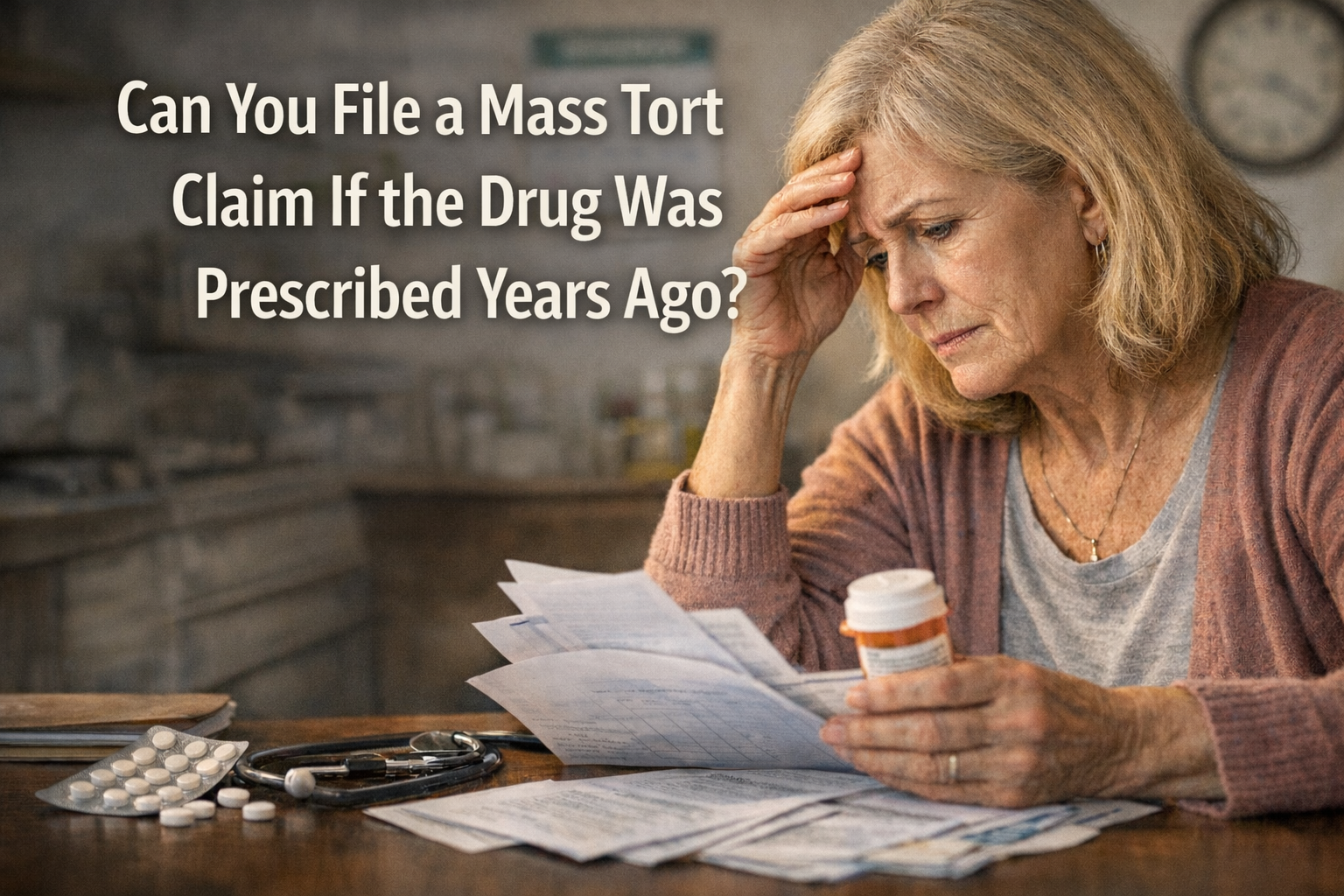
You took a medication your doctor prescribed. You trusted it was safe. Now, years, maybe even a decade, later, you’ve been diagnosed with a serious condition that may be directly linked to that drug.
And the first question that hits you isn’t just “Do I have a case?”
It’s: “Is it too late?”
This is one of the most common fears we hear from potential clients at Legal Claim Counsel. People who suffered real, documented harm from dangerous pharmaceuticals- but assumed that because the prescription was old, the door to justice had closed.
Here’s the truth: the clock may not have started when you first took the pill. In many cases, it started when you discovered or should have discovered the connection between the drug and your injury. That distinction can make all the difference.
This guide will walk you through everything you need to know about filing a mass tort claim years after a drug was prescribed, including how statutes of limitations work, the “discovery rule” that protects late-diagnosed victims, real-world examples from major pharmaceutical litigation, and exactly what steps to take right now.
Contact us today for a free, confidential case review →
Why People Wait And Why Waiting Doesn’t Always Disqualify You
Before diving into the legal details, it’s worth understanding why people don’t file claims right away.
The reality is, pharmaceutical harm is often slow, hidden, and misdiagnosed.
You might take a drug for five years and not develop cancer until year seven. You might be diagnosed with a condition in year two, but your doctor attributes it to genetics not the medication. You might spend years being told your symptoms are “unrelated” before research finally connects the dots. You might not even hear about the mass tort litigation until you see a news story or an attorney advertisement years after stopping the medication.
None of this disqualifies you.
The law — in most states and at the federal level recognizes that pharmaceutical harm is different from, say, a car accident where injury is obvious and immediate. For that reason, legal systems have built-in protections for people in exactly your situation.
Understanding the Statute of Limitations in Drug Injury Cases
A statute of limitations is the legal deadline by which you must file a lawsuit. Miss it, and you typically lose your right to compensation permanently.
In personal injury and pharmaceutical product liability cases, most states set the statute of limitations between 2 and 4 years. Some states allow longer windows. A few are shorter.
But here’s where many people make a costly mistake: they assume the clock started running the day they were first prescribed the drug.
That is often not how pharmaceutical injury law works.
The Discovery Rule: Your Most Important Protection
The discovery rule is a legal doctrine that delays the start of the statute of limitations clock until the plaintiff knew or reasonably should have known that:
- They suffered an injury, and
- That injury was likely caused by the drug in question
This distinction is critical. Courts have consistently recognized that with pharmaceutical harm, victims cannot always be expected to connect their diagnosis to a specific medication on day one. The science may not yet exist to establish the link. The FDA may not have issued warnings. Doctors may have attributed the condition to other causes.
Under the discovery rule, your limitations period may not begin until:
- You received a diagnosis of the injury linked to the drug
- Your doctor or specialist identified the drug as a possible cause
- You read or heard credible news coverage establishing the drug-injury connection
- You received an FDA safety warning directly linking the medication to your condition
- You were contacted by an attorney conducting outreach about the specific litigation
In other words, “I didn’t know the drug caused my injury until last year” is a legitimate legal argument and in many cases, a winning one.
The Fraudulent Concealment Doctrine: When Drugmakers Hid the Truth
There is another critical legal doctrine that can extend or toll (pause) the statute of limitations in pharmaceutical cases: fraudulent concealment.
If a drug manufacturer knew about the dangerous risks of its product and actively suppressed, concealed, or misrepresented that information to the FDA, to doctors, or to the public courts can toll the limitations period entirely for the time the truth was hidden.
This is not hypothetical. It has played out in some of the largest pharmaceutical litigations in history:
- Zantac (ranitidine): Internal research showed NDMA contamination for years before the FDA acted. The concealment of this data has been central to the litigation’s timeline arguments.
- Roundup (glyphosate): Internal Monsanto documents revealed company employees questioned the safety data while publicly defending the product as safe.
- Talcum powder: Johnson & Johnson internal documents showed executives were aware of asbestos contamination concerns decades before public disclosure.
In these cases and others, plaintiffs have successfully argued that they should not be penalized for failing to file a claim when the defendant was actively hiding the very information that would have prompted the claim.
If you took a drug and the manufacturer later faced regulatory action, congressional scrutiny, or internal document disclosures you may have a viable claim regardless of when your prescription was filled.
State-by-State Variation: Why Where You Live Matters
While the discovery rule applies broadly, the details vary by state. Some key differences include:
Longer limitations windows: California (2 years from discovery), Illinois (2 years), New York (3 years), and several others have plaintiff-friendly rules that courts have interpreted broadly in pharmaceutical cases.
Discovery rule application: Most states apply the discovery rule to pharmaceutical cases, but a handful require that harm be “objectively discoverable” within a certain timeframe regardless of actual knowledge.
Statutes of repose: Some states have absolute filing deadlines called statutes of repose that cut off claims after a fixed number of years from the last exposure or prescription, regardless of when discovery occurred. These vary widely (10 to 12 years in some states) and are a critical factor your attorney must analyze.
Minors and incapacitated persons: In most states, the limitations clock doesn’t start until a minor turns 18 or an incapacitated person regains capacity. If a child was harmed by a drug prescribed to them years ago, they may still have a valid claim today.
This is why working with an experienced mass tort attorney is essential. Statutes of limitations are jurisdictionally specific, and a calculation error can permanently extinguish your rights. An attorney will evaluate your state’s rules, the discovery rule applicability, any tolling arguments, and your individual timeline before advising you on whether you still have a viable claim.
Real-World Examples: Mass Torts Filed Years After Prescription
The best evidence that you can still file despite years passing? The fact that successful mass tort cases happen every day involving prescriptions that are years sometimes decades old.
Zantac (Ranitidine) Litigation
Zantac was one of the best-selling drugs in the world, widely prescribed from the 1980s onward. The FDA requested its withdrawal from the market in April 2020 after finding that the active ingredient ranitidine could degrade into NDMA, a probable human carcinogen, over time and at elevated temperatures.
Plaintiffs who took Zantac in the 1990s, 2000s, and 2010s and developed bladder, stomach, esophageal, and other cancers have filed and continue to file mass tort claims. Their prescription dates stretch back 30+ years in some cases. Courts have allowed these claims to proceed under discovery rule arguments because plaintiffs could not have known about the NDMA contamination until regulatory disclosure and media coverage made it knowable.
Roundup (Glyphosate) Litigation
Roundup has been used by homeowners, farmers, and groundskeepers for decades. Plaintiffs in the Roundup mass tort began filing in earnest after the International Agency for Research on Cancer classified glyphosate as “probably carcinogenic to humans” in 2015.
Many plaintiffs had been using Roundup for 10, 15, or even 20 years before filing. Their statute of limitations clock in most jurisdictions began running in 2015 or later when the carcinogenic link became publicly known and scientifically established.
Bayer (which acquired Monsanto) has paid out billions in settlements, many to plaintiffs with exposures dating back decades.
Depo-Provera Brain Tumor Litigation
Depo-Provera, the injectable contraceptive used by millions of women, has been linked in recent research to a significantly elevated risk of meningioma a type of brain tumor. Women who received Depo-Provera injections years or even decades ago are now filing claims as the science establishing the link has emerged and strengthened.
This is a textbook discovery rule scenario: the harm (meningioma) often develops years after use, and the causal link to Depo-Provera has only become established in recent scientific literature. Women who were prescribed Depo-Provera in the 2000s and 2010s are currently eligible to file claims.
Talcum Powder Litigation
Talcum powder cases against Johnson & Johnson involve women who used baby powder for personal hygiene some for 20, 30, or 40 years before being diagnosed with ovarian cancer or mesothelioma. The litigation has produced billions in verdicts and settlements. Courts accepted claims from plaintiffs who used the product for decades, applying discovery rule principles to determine when the cancer-talc connection became sufficiently known.
The “Latent Injury” Factor: Why Some Harms Take Years to Appear
One of the strongest arguments for why old prescriptions can still support valid claims is the biological reality of latent injuries harm that takes years or even decades to manifest clinically.
Unlike a broken bone that shows up immediately, many drug-related harms operate on long latency periods:
Cancer linked to pharmaceutical exposure can take 5–20 years to develop to a diagnosable stage. The cells damaged by the drug may undergo a slow progression from abnormal growth to a malignant tumor that only becomes detectable years later.
Neurological conditions such as the meningiomas linked to Depo-Provera can take many years to grow to a size that causes symptoms or shows up on imaging.
Organ damage from medications liver fibrosis, kidney disease, cardiac conditions may develop silently over years before clinical signs emerge.
Reproductive harm from drugs like DES (diethylstilbestrol) actually caused harm in the children of women who took the drug, with effects appearing in adulthood.
Courts have long recognized that holding victims to a “day of exposure” standard would be profoundly unjust in latent injury cases. This is why the discovery rule was developed, and it is why your claim may be very much alive even if your prescription is years old.
What Documents You’ll Need from Years Ago (And How to Get Them)
One legitimate challenge in older prescription cases is documentation. Records from 5, 10, or 15 years ago can be harder to retrieve but they’re not impossible to find, and an experienced mass tort attorney will know exactly how to help.
Here’s what matters and where to find it:
Prescription Records
Pharmacy records are your first stop. Federal law requires pharmacies to retain prescription records for a minimum of 2 years, but many state laws require 5–10 years. Major chain pharmacies (CVS, Walgreens, Rite Aid) often retain records for 10 years or more, and some have digital archives going back even further.
Your pharmacist can provide a full prescription history. This is often the single most important document in establishing that you took the drug.
Your prescribing physician’s records will also contain the original prescription, along with clinical notes, dosage adjustments, and duration of treatment. Physicians are generally required to retain records for 7–10 years, though many retain them longer. If your original doctor has retired or passed away, records are often transferred to another provider or a medical records storage service.
Medical Records
You’ll need records showing:
- The dates and duration of your drug use
- Any adverse event notes from your doctor
- Your diagnosis and when it was made
- All treatment records related to the injury
Even if your records seem incomplete, your attorney can issue subpoenas and work with healthcare providers to reconstruct your treatment history.
Insurance Records
Your health insurance company maintains claims records that can corroborate your prescriptions and treatments. Medicare and Medicaid have similar records. These can be invaluable when pharmacy or physician records are incomplete.
Your Own Records
Don’t underestimate what you may have at home: old pill bottles, insurance EOB statements, appointment reminder cards, patient portal printouts, or even photographs of medication bottles can serve as supporting evidence.
The key takeaway: missing or incomplete records do not automatically disqualify you. An attorney can help reconstruct the documentation picture, and corroborating evidence from multiple sources can be just as compelling as a single complete record.
How the Mass Tort Process Works for Older Claims
If you file a mass tort claim with a prescription from several years ago, the process generally follows the same path as any mass tort but with some additional focus on the statute of limitations and discovery rule analysis upfront.
Step 1: Free Case Evaluation Your attorney reviews your exposure timeline, diagnosis date, and state of residence to determine whether your claim is within the statute of limitations or whether the discovery rule or tolling doctrines keep it alive.
Step 2: Medical Record Collection Given the older timeline, record collection becomes a priority. Your legal team will issue requests to pharmacies, physicians, hospitals, and insurers simultaneously to build a complete picture.
Step 3: Case Filing and MDL Consolidation If your claim proceeds, it will typically be filed in federal court and consolidated with other similar cases in a Multidistrict Litigation (MDL). The fact that your prescription is older is not unusual MDLs routinely include plaintiffs with varying exposure windows spanning many years.
Step 4: Discovery and Bellwether Trials The MDL process moves forward as with any mass tort, with document discovery, depositions, and bellwether trials establishing settlement values for all injury types.
Step 5: Settlement or Trial The overwhelming majority of mass tort cases approximately 95% resolve through settlement. Your compensation is based on injury severity, medical expenses, and other factors, not on how recently you were prescribed the drug.
For a detailed breakdown of each phase, see our complete guide: What Happens After You Submit a Mass Tort Claim? A Step-by-Step Timeline.
Frequently Asked Questions
1. What if I can’t remember exactly when I started taking the drug?
Exact dates are helpful but not always required. Pharmacy records, insurance claims, and physician notes can establish an approximate timeline that is sufficient for most litigation purposes. Courts and settlement administrators recognize that people don’t memorize prescription dates. Work with your attorney to reconstruct the timeline using available records.
2. What if my doctor never told me the drug was dangerous?
This is extremely common and it does not hurt your claim. In fact, it often strengthens it. Most pharmaceutical mass tort plaintiffs were not warned by their prescribing doctors, because the doctors themselves didn’t know about the risks. The claim is against the drug manufacturer for failing to adequately warn the medical community and the public, not against your doctor.
3. What if I stopped taking the drug years ago?
Stopping the drug years ago is fine. What matters is whether you took it during the relevant exposure period and whether you suffered an injury linked to it. In many cases such as cancer or organ damage the harm was already done during the period of use, and a later diagnosis still supports a valid claim.
4. What if I’ve already received some compensation from another source?
Receiving workers’ compensation, disability benefits, or insurance payouts does not necessarily bar a mass tort claim. However, there may be lien obligations meaning some portion of your mass tort recovery goes to reimburse those prior payments. Your attorney will address these as part of the case. Don’t assume prior compensation means you can’t file.
5. Can I file a claim on behalf of a deceased family member?
In most states, the estate of a deceased person can file a wrongful death or survival action even years after the death, provided the statute of limitations has not expired (which again is often calculated from the date the drug-injury connection was known, not the date of death). If a family member died from a condition linked to a prescription drug, speak with an attorney immediately surviving family members are often entitled to significant compensation.
Don’t Let Fear of the Clock Stop You From Acting
The single biggest mistake people in your situation make is assuming it’s too late without ever asking.
Every week, people contact Legal Claim Counsel convinced their claim is time-barred and every week, our attorneys find that the discovery rule, fraudulent concealment doctrine, or state-specific tolling provisions keep their claims very much alive.
But here’s the critical flip side: waiting further genuinely can kill your claim.
If you haven’t yet spoken with an attorney, every day you wait is a day that moves you closer to an actual deadline. Records become harder to retrieve. Witnesses become harder to locate. And at some point, even the most plaintiff-friendly state law will say enough time has passed.
The answer is not to panic. The answer is to act starting with a free, no-obligation conversation with an experienced mass tort attorney who can evaluate your specific situation and give you a real answer.
Why Choose Legal Claim Counsel
At Legal Claim Counsel, we handle pharmaceutical mass tort claims across all 50 states. We understand the unique challenges of older-prescription cases from record reconstruction to statute of limitations analysis and we’ve helped clients file valid claims years after their prescriptions were written.
What we offer:
✓ Free, confidential case review– no cost, no commitment, no pressure
✓ No upfront fees– we work on contingency, meaning you pay nothing unless we win
✓ Nationwide coverage– licensed to handle cases in every state
✓ Experienced pharmaceutical litigation team– we know the science, the law, and the defendants
✓ Personal case management– you’ll always know where your case stands
We currently handle claims involving:
Depo-Provera Brain Tumor Lawsuits | Roundup Cancer Claims | Zantac Lawsuits | NEC Baby Formula Litigation | Talcum Powder Cancer Cases | Hair Relaxer Lawsuits | AFFF Firefighting Foam Exposure | Paraquat Lawsuits | Hernia Mesh Claims
Act Now- Time Is the One Thing You Can’t Get Back
The most important thing you can do today is find out where you stand.
If you or someone you love suffered a serious injury that may be linked to a prescription drug, the fact that the prescription was written years ago does not automatically close the door. The discovery rule, fraudulent concealment doctrine, and state-specific tolling provisions exist precisely for situations like yours.
But the window, while potentially open, is not infinite.
Contact Legal Claim Counsel now for your free, confidential case evaluation →
Our team is ready to review your case, answer your questions honestly, and tell you exactly whether and how you can still pursue the compensation you deserve.
You trusted that medication.
It may have betrayed that trust.
Now it’s time to find out if justice is still within reach.
Legal Disclaimer
This content is provided for informational purposes only and does not constitute legal advice. Reading this article does not create an attorney-client relationship. Statutes of limitations and legal doctrines vary by state and individual circumstance. For specific legal advice about your situation, please contact our office for a free, confidential consultation.
Related Articles: